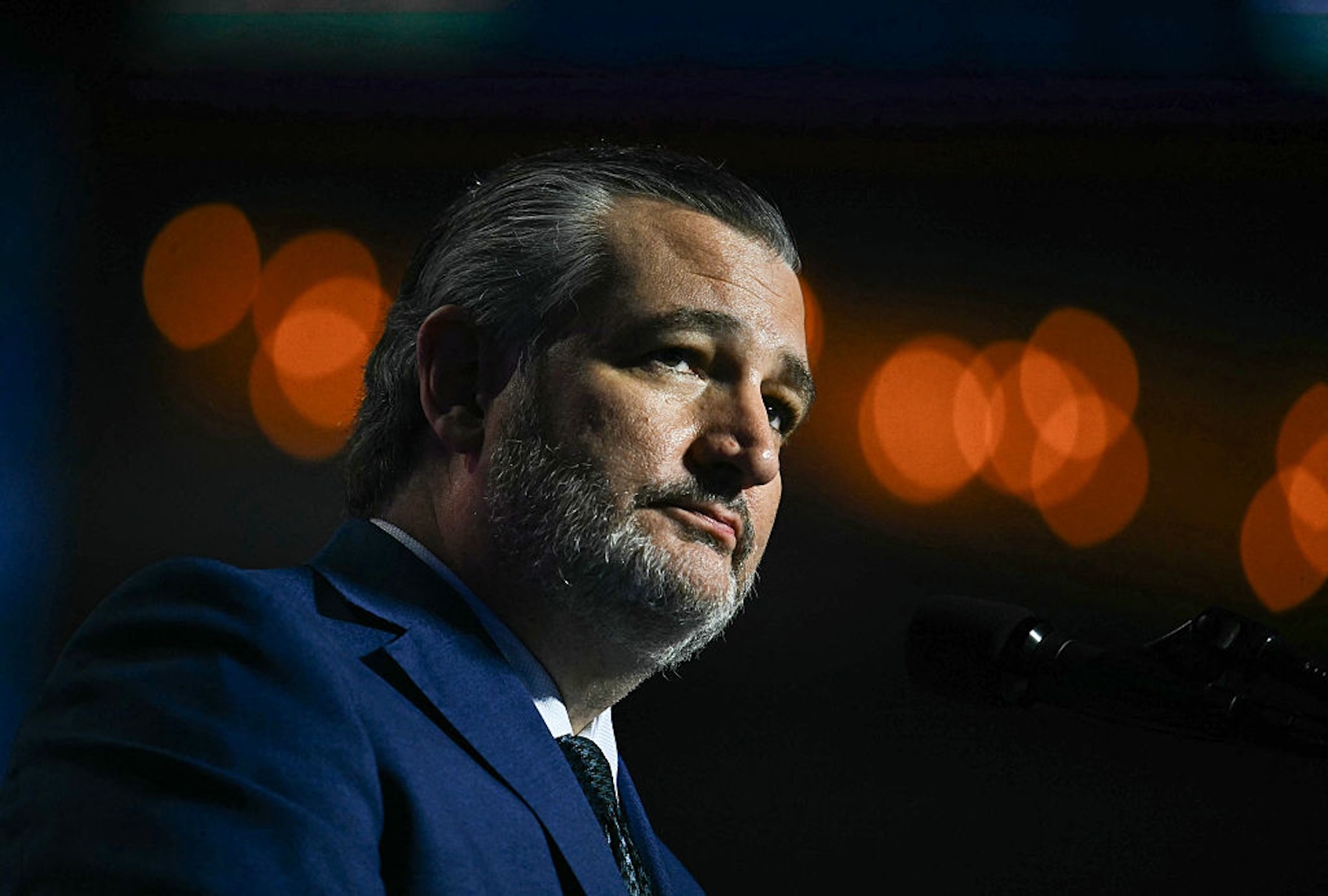
When Texas Sen. Ted Cruz walked onto the “College GameDay” set on the University of Texas campus ahead of the Longhorns’ showdown with Ohio State, he was greeted by a raucous Austin crowd that drowned out host Rece Davis. “Ted, you suck! Ted, you suck!” several hundred students chanted for nearly 10 minutes on Saturday morning, standing behind the Republican and booing as Davis attempted to conduct a one-on-one interview. Cruz was on the most-watched college football program in the nation to make the case that Congress should “bring order to chaos” in college sports. But by the time it was over, clips of “Ted, you suck” drowned out everything the senator actually said about the Protect College Sports Act.
The segment was funny, not to mention deservedly embarrassing. But as a casual observer of college football, ESPN’s offer to Cruz initially struck me as a baffling spectacle. Why would a corporate giant like Disney — ESPN’s parent company — long perceived as culturally progressive and frequently at odds with conservative politicians, hand 10 minutes of prime, uninterrupted broadcast time on its flagship sports show to a controversial Republican senator? Why subject its premiere college football brand to an awkward political lecture that its core audience clearly did not want? And, as several people questioned on social media, why hand Cruz an unvetted platform on ESPN during the same week that ABC, another Disney-owned company, pulled Texas’s Democratic Senate nominee James Talarico from the “Jimmy Kimmel Live!” broadcast schedule over regulatory fears?
What happened on “College GameDay” this weekend is not about a bad booking decision. It’s about what Disney is actually afraid of — which is not the Federal Communications Commission, nor the appearance of political bias.
What happened on “College GameDay” this weekend is not about a bad booking decision. It’s about what Disney is actually afraid of — which is not the Federal Communications Commission, nor the appearance of political bias. Ultimately, this came down to corporate self-preservation.
While Disney plays a delicate game of regulatory defense with FCC chair Brendan Carr on over-the-air television, its sports media empire is facing an existential economic crisis. Cruz was on ESPN because Disney needs a statutory lifeline — and they were willing to swallow 10 long minutes of deafening boos to secure it.
ESPN has a direct economic stake in the legislation Cruz was promoting. Strip away the lofty rhetoric about “saving amateur sports” and the Protect College Sports Act is essentially a massive, industry-backed bailout package. Co-sponsored by a mix of Republicans and Democrats, the bill could help preserve the conference-based rights marketplace on which ESPN’s college-sports business depends.
The network’s entire multi-billion dollar business model rests on a structural foundation that, for decades, signs athletic conferences like the SEC or the Big Ten on a single media rights contract. But that highly-profitable model is currently crumbling as courts are increasingly treating college athletic conferences as cartels engaged in anti-competitive price-fixing. The alternative, buying media rights on a school-by-school basis, would explode operating costs for ESPN. Cruz’s bill would amend the 1961 Sports Broadcasting Act to hand conferences and schools a targeted antitrust exemption for pooling and selling their media rights jointly. ESPN, Fox, Amazon and the NCAA have spent millions lobbying Congress to push this bill across the finish line.
This is why ESPN has now devoted two consecutive “GameDay” broadcasts to promoting it — first through sports commentators Nick Saban and Pat McAfee, who spent a segment the week before grading the legislation as “80% good” and demanding Congress get back from recess to finish it, then through Cruz, who floated on social media the idea of Donald Trump signing it into law live on “GameDay” this fall. When an ESPN source later explained the Cruz booking to The Athletic, the excuse offered was that it had been an “easy decision” given the timing, and that nobody opposed to the bill had asked for a comparable platform.
Want more sharp takes on politics? Sign up for our free newsletter, Standing Room Only, written by Amanda Marcotte, now also a weekly show on YouTube or wherever you get your podcasts.
That is a genuinely strange thing for a network to say out loud, because it implies that the program’s standard for balance is that if opponents don’t call, the network has no obligation to go find them. But there’s a problem with that claim: Opponents of the Protect Sports Act are not hard to find. The AFL-CIO, the Congressional Black Caucus and the NAACP have all publicly opposed the bill, arguing that its compensation caps and eligibility restrictions disproportionately burden Black athletes in football and basketball, the sports that generate the actual revenue the bill is designed to protect. Michele Roberts and DeMaurice Smith — the former heads of the NBA and NFL players’ unions, two people who spent their careers negotiating exactly the kind of compensation fights this bill would foreclose — are reportedly lobbying against it directly. Neither of them have been booked on “GameDay.” Since Cruz’s interview aired, the NAACP has demanded equal time of its own, asking that its president, Derrick Johnson, appear to make the case against the bill as “dangerous to Black Athletes and the Black community” when the show travels next week to Oxford, Mississippi.
For years, critics on the right have accused Disney of being an ideological actor, pointing to its corporate positions on social issues. The “GameDay” spectacle proves Disney is neither a woke activist nor a conservative sympathizer. It is simply a cold-blooded corporate entity that operates on unadulterated self-interest. So while it may appear questionable that in the same week that Disney benched Talarico on ABC to mitigate overblown regulatory risk and invited Cruz onto ESPN to lecture a stadium full of booing college students, the company isn’t suddenly embracing conservative ideology. ESPN would have welcomed any lawmaker onto that stage if they held the keys to preserving conference media deals. Cruz just happened to be the senator carrying the water for the sports broadcast cartel.
Every media company has financial interests. That’s not the scandal. It’s that Disney is currently asking the public, implicitly, to believe two contradictory stories about itself at once — that it is a nervous, over-regulated broadcaster forced by federal pressure to silence a Senate candidate on its flagship late-night show and, simultaneously, a public square willing to hand a sitting senator 10 unchallenged minutes to lobby for legislation that benefits the corporation’s own bottom line, crowd reaction be damned.
Both of those things are true. They are just true for the same reason — and it isn’t the one Disney would prefer people believe.
Read more
from Sophia Tesfaye